
Contents
Overview
Wiki syntax is the set of markup conventions used to format content within wiki platforms, enabling users to create structured, linked, and visually organized pages without needing complex coding knowledge. It translates simple text commands into rich content, including headings, lists, bolding, italics, and crucially, internal and external hyperlinks. This lightweight markup language is the engine driving the collaborative editing process, allowing for rapid content generation and modification, a core tenet of platforms like Wiki Training. Understanding wiki syntax is fundamental for anyone contributing to or managing knowledge bases, wikis, or collaborative documentation systems, as it dictates how text is interpreted and displayed. Its design prioritizes ease of use and speed, reflecting the 'quick' Hawaiian origin of the wiki concept itself, making knowledge sharing accessible to a broad audience.
🎵 Origins & History
The genesis of wiki syntax is intrinsically tied to the birth of the wiki itself. The early syntax evolved into what is commonly known as 'wikitext'. The goal was speed and accessibility, embodying the Hawaiian word 'wiki' meaning 'quick'.
⚙️ How It Works
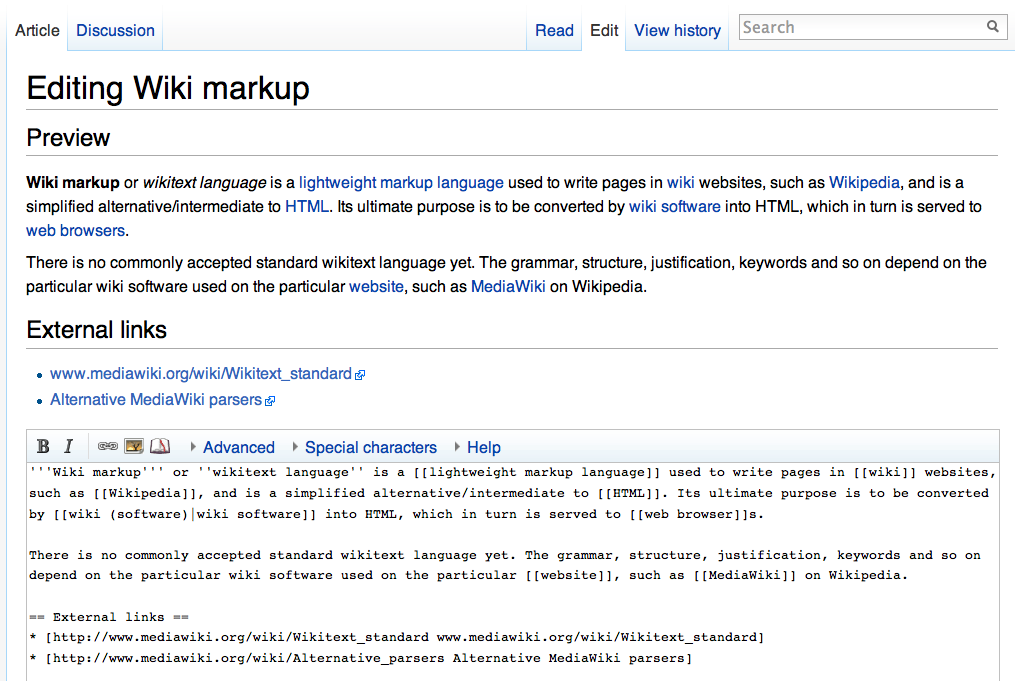
Wiki syntax operates on a principle of translating human-readable markup into structured web content. Instead of writing HTML tags, users employ specific character combinations. For instance, double apostrophes (''text'') typically render as italic text, while triple apostrophes ('''text''') become bold text. Headings are often created using multiple equals signs (== Heading ==). The most powerful feature is linking: Page Name creates an internal link to another page within the same wiki, while [http://example.com Link Text] creates an external link. This system allows for the creation of complex, interconnected knowledge bases with minimal technical overhead, forming the backbone of collaborative platforms like Wiki Training.
📊 Key Facts & Numbers
While exact global usage statistics for all wiki syntax variants are difficult to pinpoint, estimates suggest that billions of wiki pages exist worldwide, with a significant portion utilizing some form of wikitext. For example, Wikipedia, the largest wiki-based encyclopedia, employs a highly developed version of wikitext, with hundreds of thousands of active editors contributing daily. The MediaWiki software, which powers Wikipedia and many other wikis, supports a rich set of syntax features, including templates, parser functions, and extensions, allowing for dynamic content generation. Studies on wiki adoption in educational settings have shown that over 70% of institutions utilize wikis for collaborative projects, underscoring the widespread reliance on their underlying syntax.
👥 Key People & Organizations
Ward Cunningham is the pivotal figure credited with inventing the wiki and its foundational syntax. His WikiWikiWeb project laid the groundwork for all subsequent wiki implementations. The MediaWiki software, developed by Wikimedia Foundation developers, notably Magdalena Krpinska and Erik Möller, significantly standardized and expanded wiki syntax for large-scale projects like Wikipedia. Many other wiki engines, such as TiddlyWiki and DokuWiki, have their own distinct syntax variations, often developed by their respective core teams and communities, including figures like Jeremy Ruston for TiddlyWiki.
🌍 Cultural Impact & Influence
Wiki syntax has profoundly influenced how knowledge is created, shared, and organized online. It democratized content creation, moving away from top-down publishing models towards a more participatory approach. This has had a massive impact on open-source software documentation, community knowledge bases, and collaborative learning environments like Wiki Training. The ease of linking and editing enabled the creation of vast, interconnected datasets. Its cultural impact lies in empowering ordinary users to become contributors, fostering a sense of collective ownership over information, and enabling the rapid dissemination of knowledge during critical events, such as the early days of the Arab Spring.
⚡ Current State & Latest Developments
While the core principles of wiki syntax remain stable, ongoing developments focus on enhancing usability and functionality. Many modern wiki platforms now offer visual editors that abstract away the raw syntax, providing a WYSIWYG (What You See Is What You Get) experience. However, the underlying wikitext often remains accessible and is sometimes preferred by power users for its speed and precision. Projects like MediaWiki continue to evolve, introducing new syntax extensions for features like visual diffing, advanced templating, and integration with external data sources. The trend is towards a hybrid approach, where visual editors are the default, but robust syntax support persists for advanced users and specific use cases.
🤔 Controversies & Debates
A primary debate surrounding wiki syntax revolves around standardization versus flexibility. Different wiki engines employ distinct syntaxes, leading to a fragmented ecosystem where knowledge created on one platform may not be directly transferable to another without conversion. Critics argue this lack of a universal standard hinders interoperability and increases the learning curve for users who engage with multiple wiki platforms. Conversely, proponents argue that syntax variations allow for specialized features tailored to specific community needs, fostering innovation. The tension between ease of use via visual editors and the power/efficiency of raw syntax also remains a point of discussion among wiki administrators and contributors.
🔮 Future Outlook & Predictions
The future of wiki syntax likely involves a continued push towards abstraction and integration. Visual editors will become more sophisticated, potentially making direct syntax manipulation a niche skill. However, the underlying logic of wikitext will persist, powering these visual tools and remaining available for advanced users. We may see increased efforts towards syntax conversion tools or standardized intermediate formats to improve interoperability between different wiki platforms. Furthermore, as wikis integrate more deeply with AI and semantic technologies, syntax may evolve to support richer data annotation and machine-readable content, further blurring the lines between human-authored text and structured data.
💡 Practical Applications
Wiki syntax finds practical application across a vast spectrum of collaborative endeavors. It is the engine behind internal knowledge bases for corporations, enabling teams to document processes, share best practices, and manage project information efficiently. In academia, it facilitates collaborative research papers and student projects, as seen in many university training programs. Open-source projects rely heavily on wiki syntax for documenting code, APIs, and user guides, making complex technical information accessible. For community-driven projects, from local history archives to fan wikis for popular media, syntax provides the means to build shared repositories of information. Platforms like Wiki Training leverage this for structured learning modules.
Section 11
Ward Cunningham, the inventor of the wiki and its initial syntax, is a seminal figure in software development. Born in Michigan, USA, Cunningham is known for his contributions to agile software development methodologies, particularly Extreme Programming (XP) and refactoring. He also developed the first continuous integration tool, CVS Continuous Integration. His work on wikis has profoundly impacted collaborative knowledge sharing across countless organizations a
Key Facts
- Category
- content-creation
- Type
- topic